
There is a particular kind of excitement that comes with a new idea. You notice a problem, start imagining what could make it better, and before long you are already thinking about names, programs, services, or what the website might look like.
For social impact founders, that excitement can come with a sense of urgency. When the issue you care about affects people’s health, livelihoods, education, environment, or sense of belonging, waiting can feel uncomfortable. You want to do something useful.
But some of the most important work at the beginning looks much quieter.
It starts with talking to people.
Before Impact Toolbox became what it is today, our founder, Segun, interviewed around 300 people. He wanted to understand what aspiring social entrepreneurs were actually struggling with, rather than relying only on what he assumed they needed. Those conversations helped shape the thinking behind Impact Toolbox and the kinds of support it would eventually offer.
Years later, one of our team members, Laura, took a similar approach while developing her own business. She spoke face-to-face with roughly 1,000 people in her target audience. That meant hundreds of conversations, repeated questions, unexpected answers, and patterns that would have been difficult to uncover through desk research alone.

The deeper lesson in both stories is simple: listen before deciding what the answer should be. You cannot create a solution based on assumptions alone. You need to deeply understand the problems people are facing, and test out multiple solutions until one seems to resonate.
As Albert Einstein said:
“If I had one hour to save the world, I would spend fifty-five minutes defining the problem and only five minutes finding the solution. “
Albert Einstein
Your first idea is still a hypothesis
Most businesses begin with an assumption. You believe a problem exists, you have an idea about who experiences it, and you may already have a possible solution in mind.
That is a natural place to start. Almost every founder experiences this.
Maybe you have lived through the problem yourself. Maybe friends have told you they love your idea. Perhaps you have read reports that suggest there is demand.
All of that can help, but none of it replaces speaking directly with the people you hope to serve.
Their experience may be more complicated than you expect. The issue you think is most urgent may not be the one they talk about first. A feature you assume matters could be irrelevant to them. Something you barely considered may come up again and again.
Interviews help you notice where your assumptions are useful and where they need to change.
For many founders, early assumptions turn into certainty too quickly. Founders will think of a business idea and become set on it without genuinely considering if it’s the solution their community needs. A good founder will listen to their target audience, understand their genuine needs, and work on a solution together.
Research gives you context, but conversations will help you understand your business goals on a deeper level
Traditional research still matters. Reports, studies, surveys, and sector data can help you understand the broader landscape around a problem, but 10/10 times, a conversation will reveal what those sources cannot.
Reports might tell you that people struggle to access a service, but an interview may reveal that someone stopped trying because the process made them feel embarrassed or unwelcome.
A survey might show that cost is a barrier, but a conversation could reveal that unpredictability is the real issue.
These details can completely change how you design a solution because you will understand the problem on a deeper level.
For social impact founders, a key thing to consider is that when your work is tied to people’s lives and communities, building from assumptions can mean missing the reality of what people actually need.
Ask about their life before you share your idea
One of the easiest mistakes to make in an interview is explaining your solution too early.
You tell someone what you are building and ask, “Would you use this?”
Most people are kind. They’ll say yes and that it’s a great idea. They might even genuinely mean it in that moment, especially if they’re friends or family.
But people are often better at describing what they have already experienced than predicting what they might do in the future.
So, the key is to ask complete strangers who you believe might be experiencing these problems. Don’t ask friends or family as their answers will be biased. Ask them about the last time they faced the problem you are exploring. What happened? What did they try? Where did they get stuck? Did they spend money trying to solve it? What made the experience difficult?
Those answers give you behaviour, context, and stories, and they also might suggest that your original idea is not quite right.
As a founder, it’s difficult to hear, but it will help you long-term. It can also save you months of building something people never asked for.
The most valuable findings are typically unexpected
After enough conversations, patterns begin to emerge and you will get a clearer picture of what the core problems are,
One person mentions something you had not considered. A few interviews later, someone else says something similar. Then another person describes the same frustration using completely different language.
These insights are difficult to find in a spreadsheet, but they can shape almost every part of an initiative or social impact business.
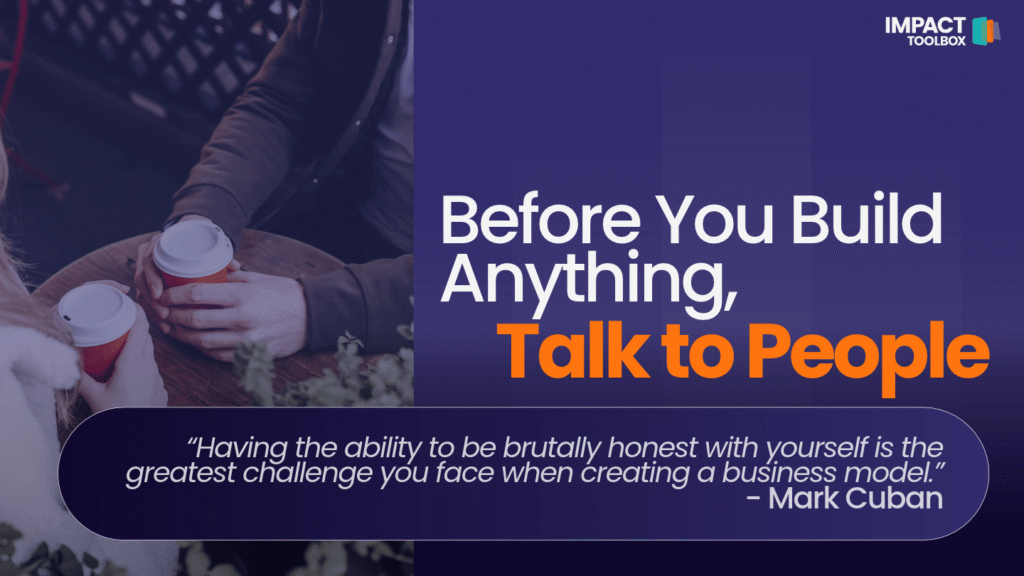
“Having the ability to be brutally honest with yourself is the greatest challenge you face when creating a business model.”
Mark Cuban
You do not need 1,000 interviews to begin
Segun, our founder, spoke with around 300 people. Laura, one of our team members, spoke with roughly 1,000.
You do not need to match those numbers. You can simply start with 5 conversations, or 10. You can interview one person a day for 2 weeks. It’s simple, requires minimal structure, but it will change the entire trajectory of your business and will lead you exactly where you need to be.
Your goal at the end of this is to become less dependent on assumptions that came only from you.
And with all of this said, the listening and interviews should not stop once you launch your business. People’s needs will evolve, communities change, new problems will appear, and as long as you continue asking questions, your work will stay connected to the people it is meant to support.
Before the website, pitch deck, or launch
There will always be pressure to build something visible like a website, logo, branding, a pitch deck, or even a business name, but doing this before having honest conversations with the people you aim to serve, will likely hurt you more than help you.
Some of the most useful work may very well leave you with nothing public to show for it. Just scribbled notes, crossed-out assumptions and hypotheses, new questions, and a clearer understanding of the people you hope to support.
This will create the most meaningful progress, more than a pretty pitch deck or fancy website ever will.
If you want to create something that speaks to people, you need to spend time speaking with people first.
“You never really understand a person until you consider things from their point of view. Until you climb inside of their skin and walk around in it.”
Atticus Finch in To Kill Mockingbird
Listen to how they describe the problem and pay attention when their answers challenge your expectations and hypothesis. Let what you hear change the idea.


